Shiga Kogen, Nagano · 3 days, 2 nights from Tokyo

Niseko is where the world skis Japan. This is where Japan skis.

The highest lift-served snow in the country, eighteen linked ski areas, and an alpine venue of the 1998 Winter Olympics — four hours from your Tokyo hotel by road, with no domestic flight. A ski school that teaches in English. An onsen hotel three minutes from the lift. And at half past eleven on the second morning, the ski club of the local elementary school comes down to the beginners' run.

Tokyo→ Shiga Kogen→ Jigokudani→ Tokyo · 2 nights · December – late March
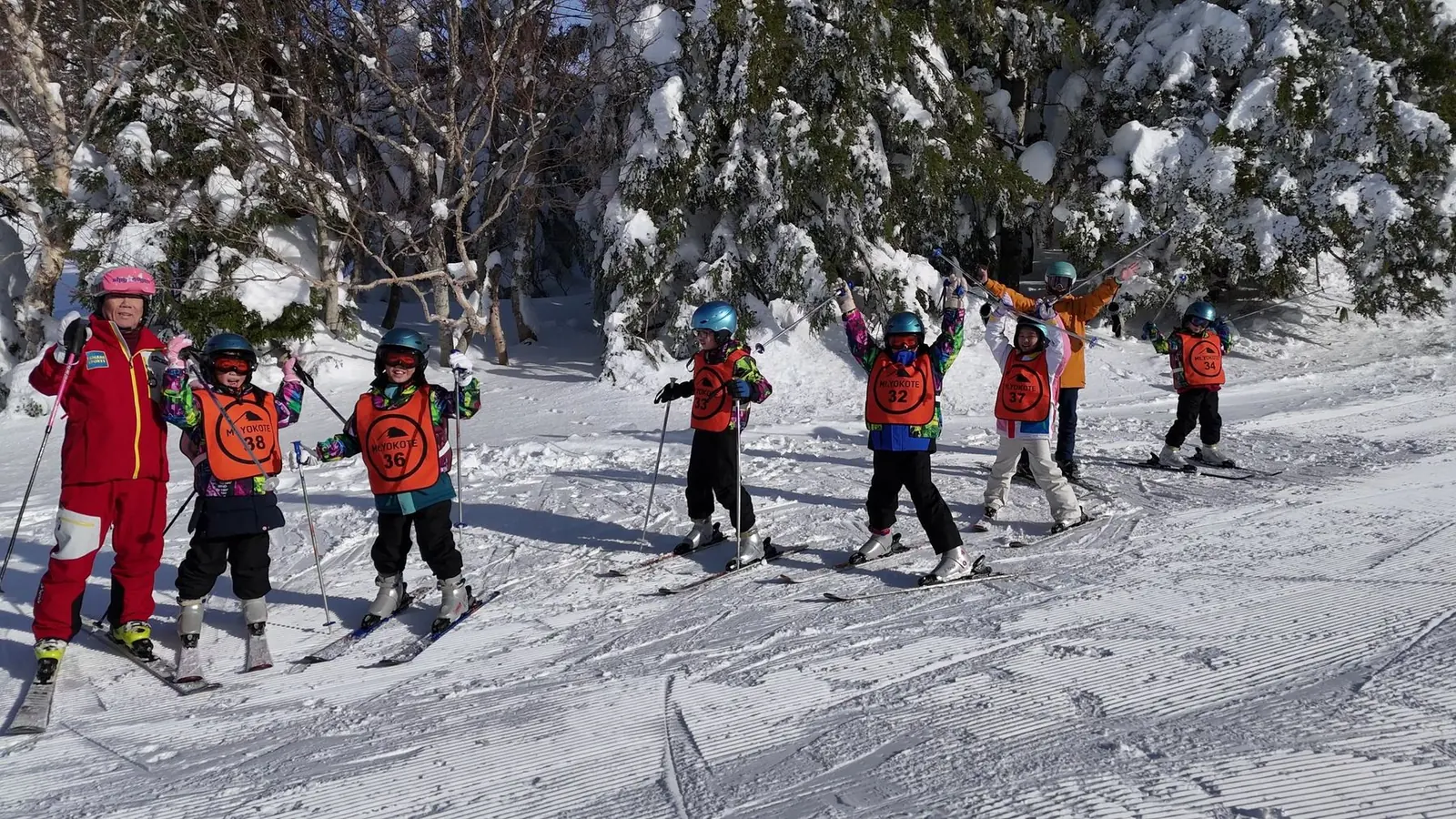
Seen from above: a line of children in orange numbered bibs on a beginners' run, an instructor in red beside them, one child with both arms in the air, snow-laden trees on either side.
Second morning, filmed from the resort's own drone. One child has just made it down without falling.
The argument

You can ski at home. That is not what this is.

Your children will learn to ski here, properly — but skiing is the admission ticket, not the product. The product is a mountain that has not been rebuilt for foreigners.

Niseko is an international resort now. English menus, Australian-run bars, a village that has arranged itself around visitors. It is very good at what it does. It is also not a reason to fly thirteen hours.

Shiga Kogen is full of Japanese school groups. That is not a line we wrote for this page — it is the reason the local elementary school's ski club is on the same beginners' run as your children on the second morning. We did not arrange that. That is simply who else is on the mountain.


Before you read further

Who this is for, and who it is not for.

This is for

  • Children who have never skied, or who have skied twice. The teaching is built for exactly that and the beginner runs are long and gentle.
  • Two or three families travelling together. Ten people is the practical size.
  • School groups. We ran eighty children here in January 2025.
  • Families who want Japan in winter — the onsen, the snow country, the food — with the skiing as the spine of the day.

This is not for

  • Anyone chasing steep terrain or backcountry. This programme lives on the beginner and intermediate runs, with an instructor, all day.
  • Anyone who wants a resort where the whole village speaks English. The ski school teaches in English. The village does not. That is the point of coming, but know it first.
  • Anyone who needs true ski-in, ski-out. It is a three-minute walk in ski boots, carrying skis. With small children that is a real three minutes.
  • A single family travelling alone. The coach from Tokyo costs the same for four people as for twenty, and it shows in the price.

The mountain

Two thousand three hundred and seven metres.

Eighteen ski areas, linked, roughly 2,600 hectares. The high point is Mt. Yokote at 2,307 metres — the highest you can reach by lift anywhere in Japan, which is why the hotel at its foot is called 2307.

Altitude is the whole argument. It is what keeps the snow dry and cold through the season rather than turning heavy in February, and it is why Yokoteyama holds its season later into spring than anywhere else in Shiga Kogen. The snow here is natural.

The alpine events of the 1998 Nagano Winter Olympics were held in this resort, at Higashidateyama and Yakebitaiyama. Your children will not be skiing those runs. But it tells you what the mountain is.
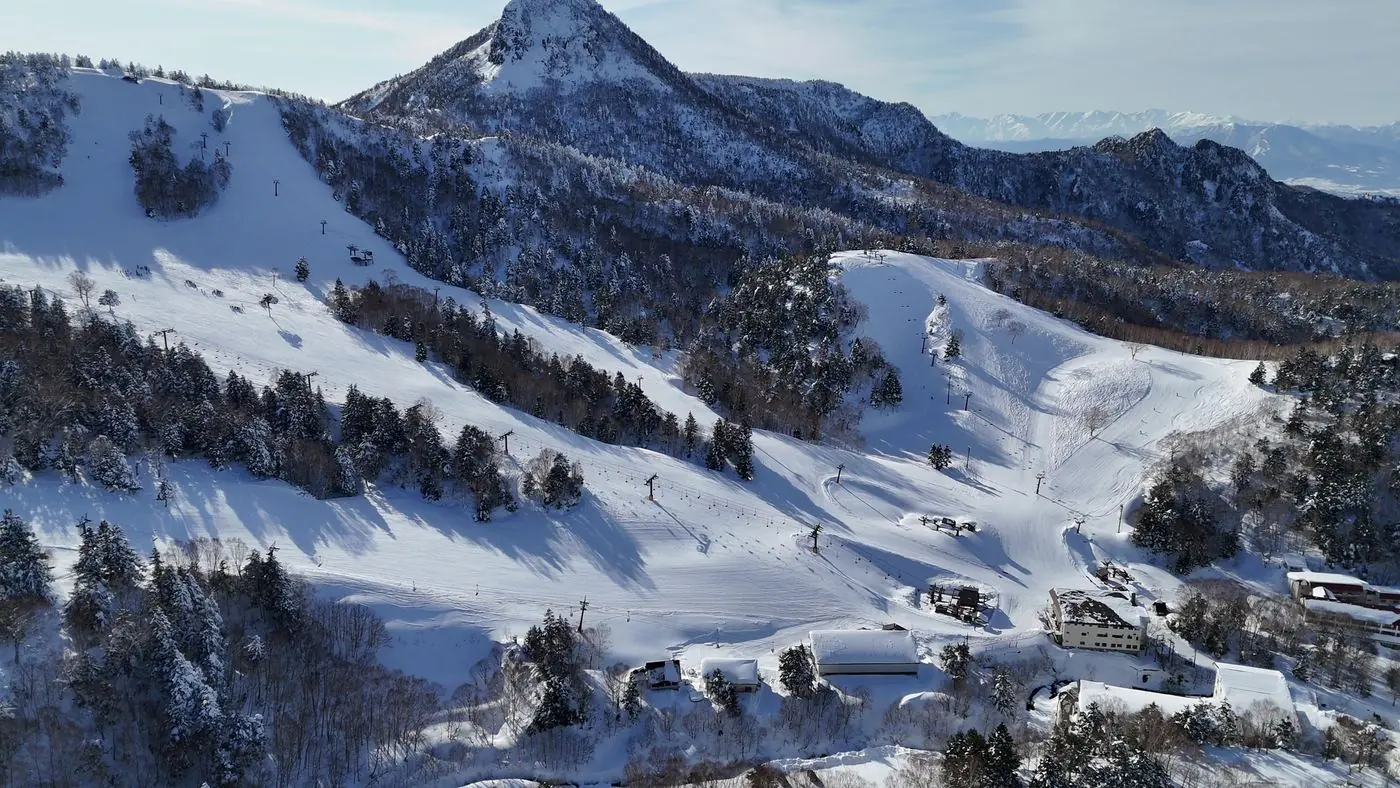
An aerial view across Shiga Kogen: a sharp snow-covered peak, ridgelines behind it, a few buildings and a road far below, the distant range visible on the horizon.
Looking across the resort from the drone. The ridge on the horizon is the Northern Alps.
Highest lift point2,307 mMt. Yokote
Linked ski areas18≈2,600 ha
SeasonDec – late MarJan–Feb best
From Tokyo~4 hrsby road, no flight
SnowNatural
1998 OlympicsAlpine venue

The second day

Learning to ski, in one day.

The resort's own ski school teaches in English and in Japanese. Five or six children to an instructor. Four lesson periods across the day — two hours in the morning, two in the afternoon, with lunch at the hotel in between.

In January 2025 we brought eighty children here from Guangzhou, a city where it is summer all year and where not one of them had stood on snow. They were skiing an easy run on their own by the afternoon.

The snow is why. It is deep and soft enough that falling does not hurt — so a child falls, gets up, gets back on the skis, and falls again, twenty times in a morning. That is the entire method. A hard, icy slope teaches a child to be afraid of the hill.
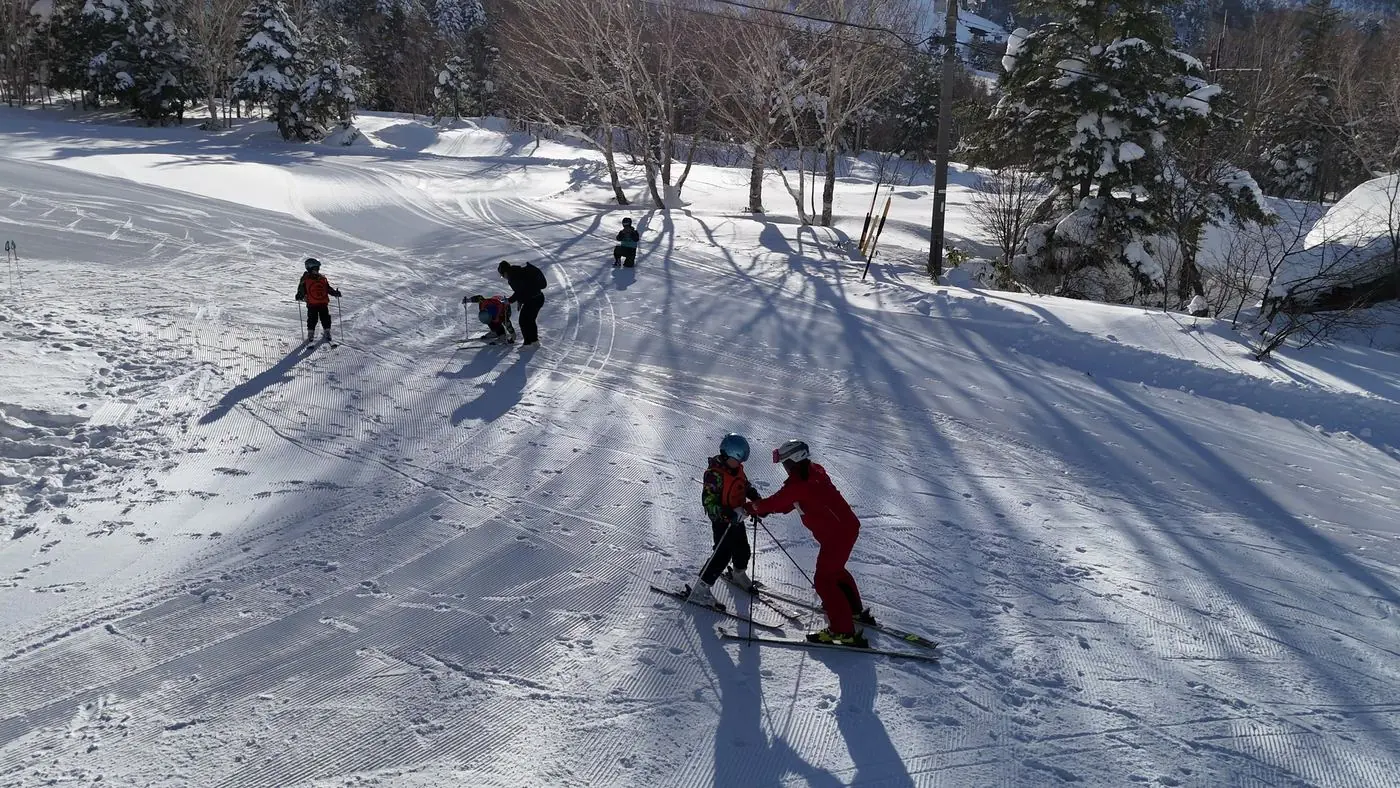
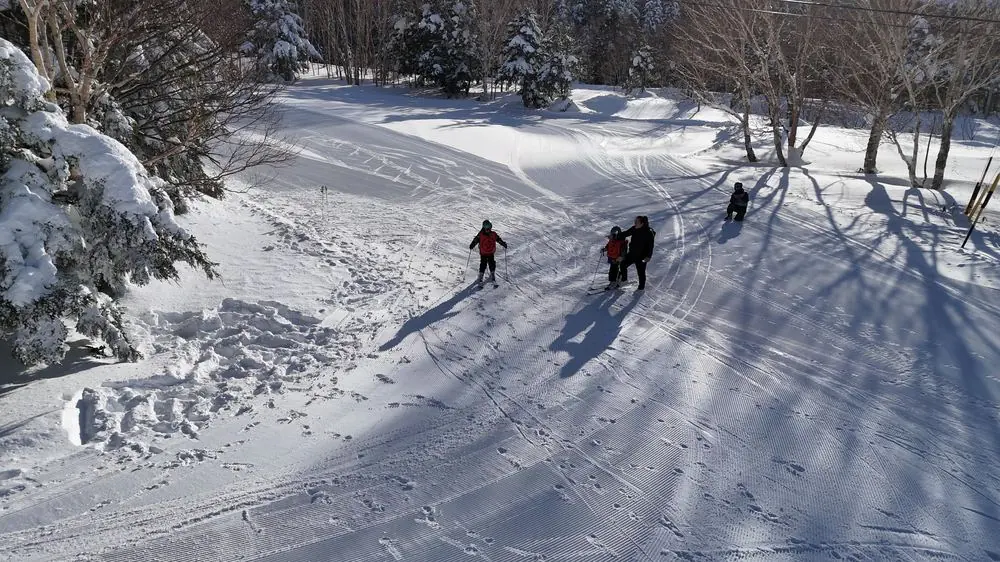
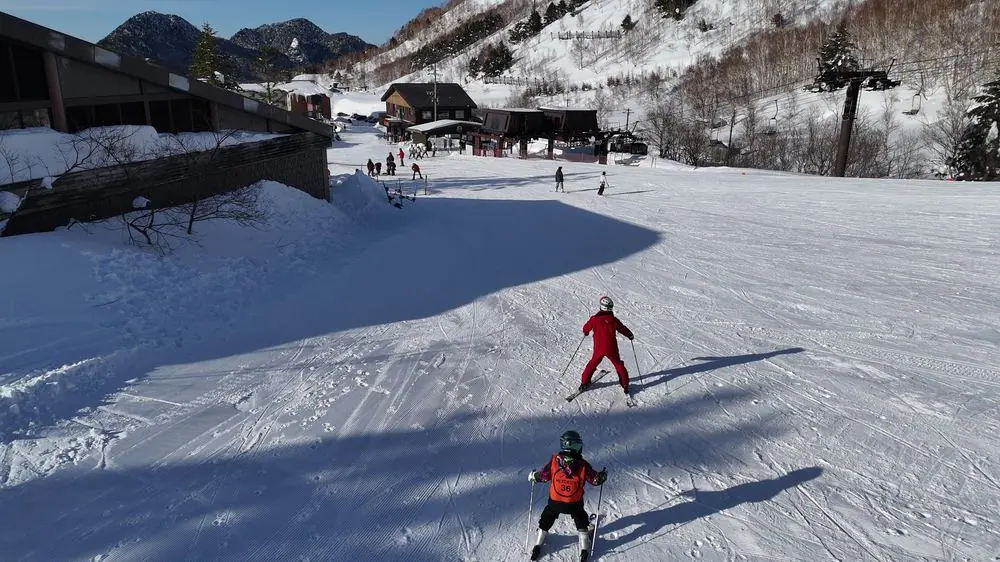
Seen from above: a single child in an orange bib skiing down a wide groomed run, an instructor in red a few metres behind, long blue shadows of bare trees across the snow.
One at a time, down the beginners’ run, with the instructor never more than a few metres away.
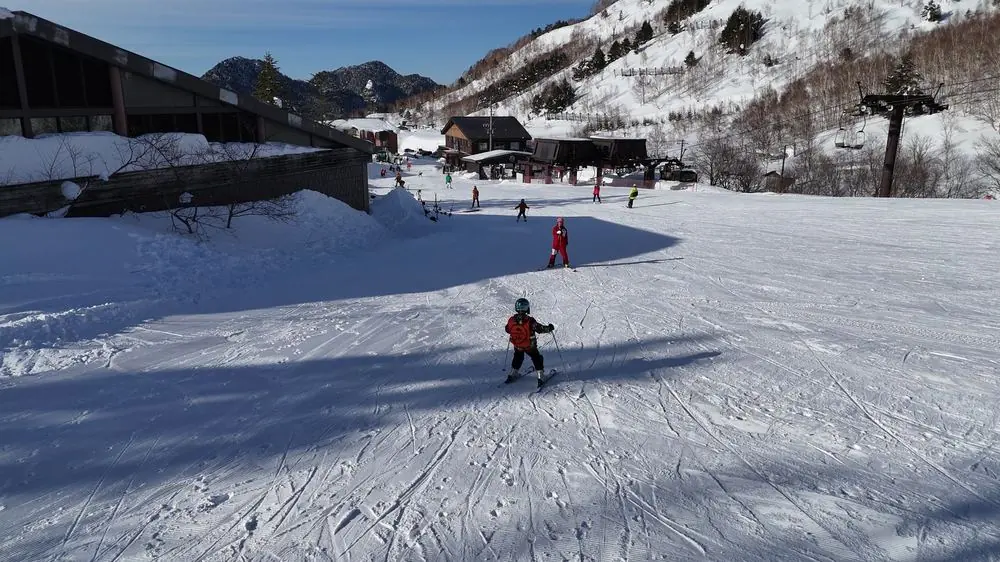
A child skiing alone down the run from above, the instructor watching from higher up the slope.
A child in an orange bib skiing towards the camera with the hotel roofline visible at the top of the frame.

By the afternoon most of them are going down without anybody holding on.

What the morning actually looks like

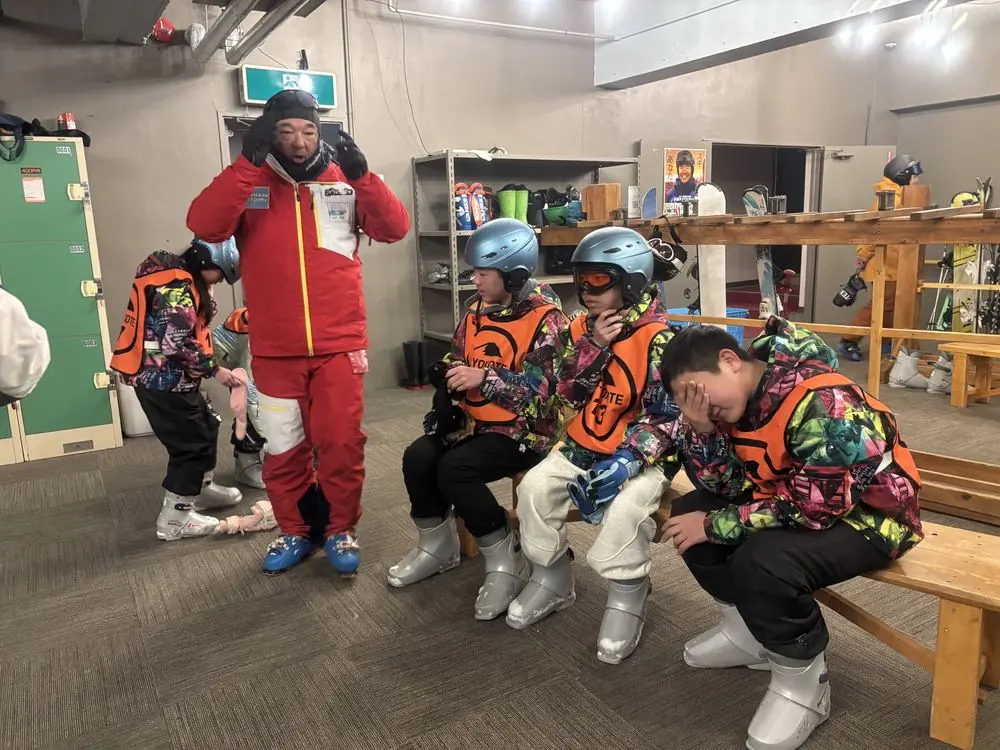
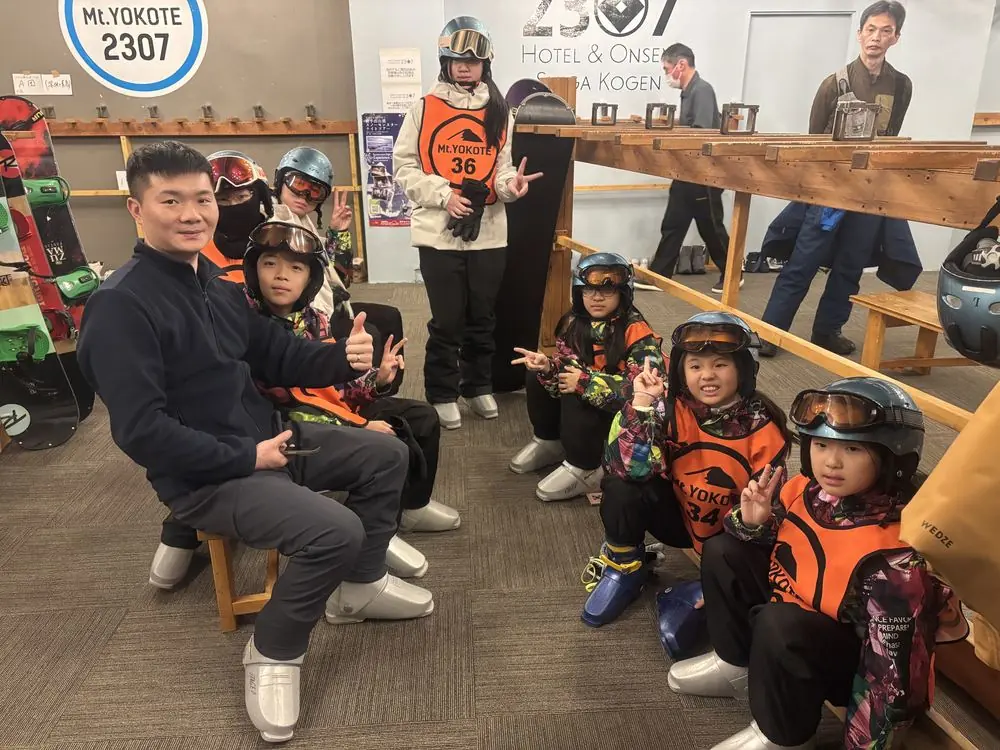
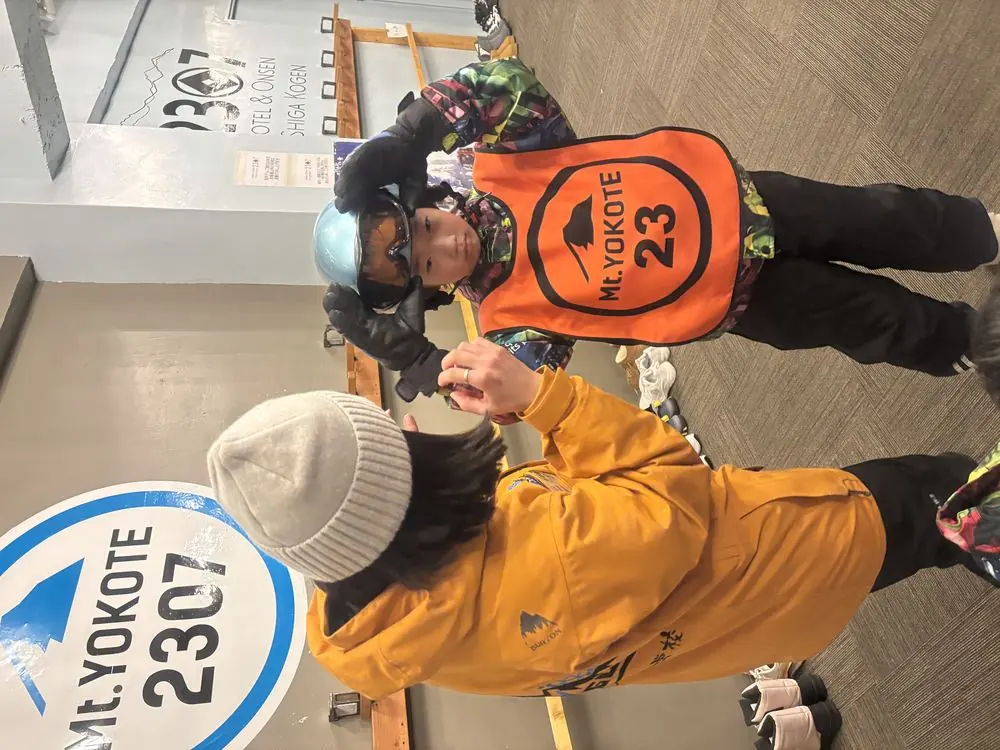
Snowsuits are sized before you arrive — we collect heights in advance — and they are in the room, labelled with each child's name, on the evening you check in. Boots, helmets, goggles and gloves are named and waiting in the equipment room on the basement floor. Nobody queues at a rental counter in a foreign language on the first morning.
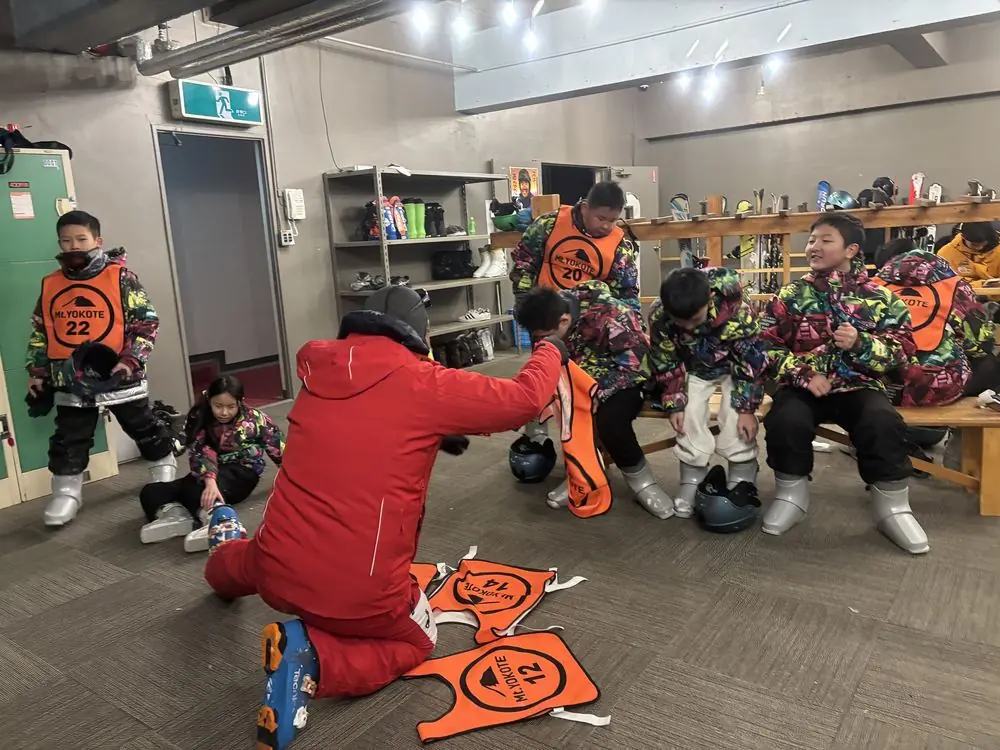
An instructor in a red ski suit kneeling on the floor of the equipment room, fastening a ski boot for a child, other children sitting on a bench in orange numbered bibs.
An instructor helping a boy pull his goggles down over his helmet, a large Mt. Yokote 2307 sign on the wall behind them.
The instructor standing in the equipment room demonstrating with his hands, three children sitting on the bench in ski boots watching him.
A group of children sitting in the equipment room in bibs and helmets with a teacher, skis and boards racked on the wall behind.

The equipment room is in the basement of the hotel. Everything already has a name on it.

InstructionEnglishand Japanese
Ratio1 : 5–6children
Lessons4 periods2h AM + 2h PM
LunchAt the hotel
IncludedSkis · suitboots, helmet, goggles, gloves
Lift passIncluded

One true thing. This is a learn-to-ski programme. A child who already skis well will be bored by the afternoon — tell us in advance and they go in a different group.

For the eighty-child group we ran ten children per group with two instructors each, and we brought in a Chinese-speaking instructor from another Nagano resort so those children could hear everything twice. The English instructors are permanent staff at the ski school and need no special arrangement. The Chinese instructor was ours. That is the kind of thing we will do for a group if it matters.


Half past eleven

The local school's ski club comes down the same run.

Yamanouchi Higashi Elementary School has a ski club. On a weekday in January they train on the same beginners' run your children are on, and at about 11:30 they arrive.

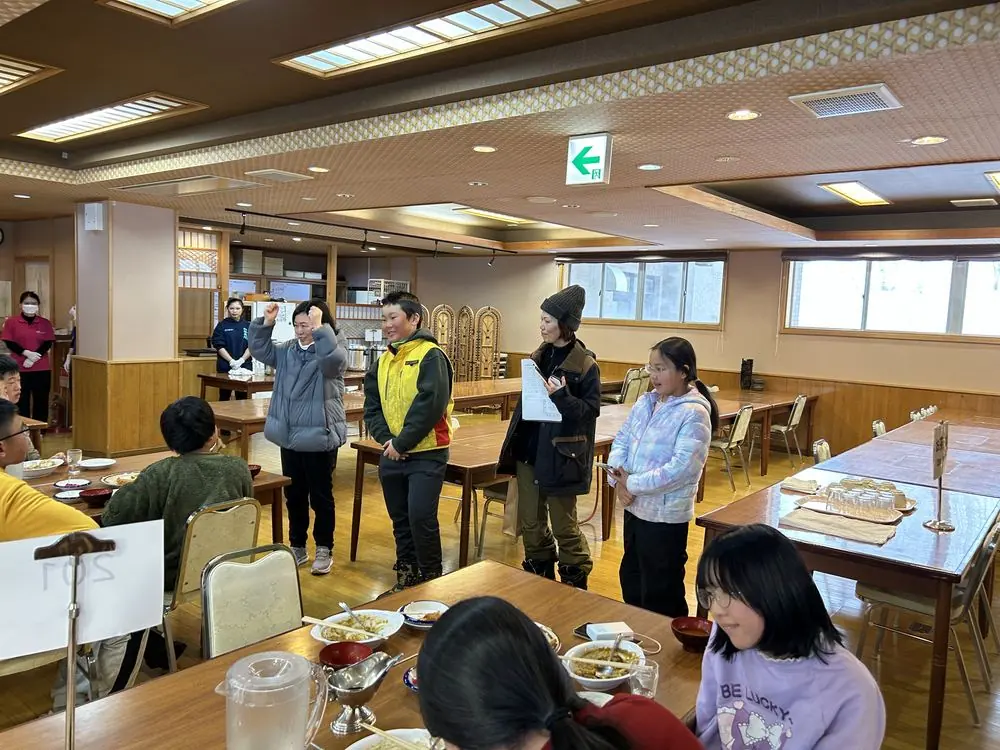
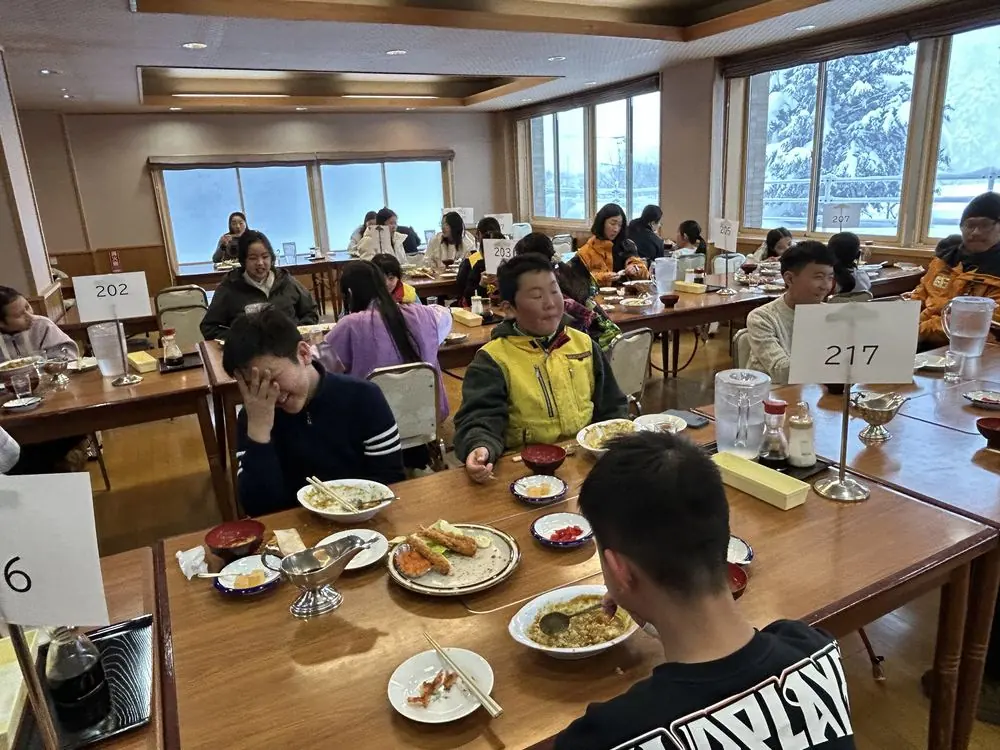
They ski together for the last half hour of the morning lesson. Then everybody goes back to the hotel and eats lunch in the same dining room — the Japanese children explaining how long they have been skiing and how often they train, the visiting children explaining what they do after school. Small presents change hands. Somebody takes a photograph.

This is the part that is difficult to buy. It runs through the international exchange division of the Nagano Prefecture tourism organisation, and it needs about three months' notice.
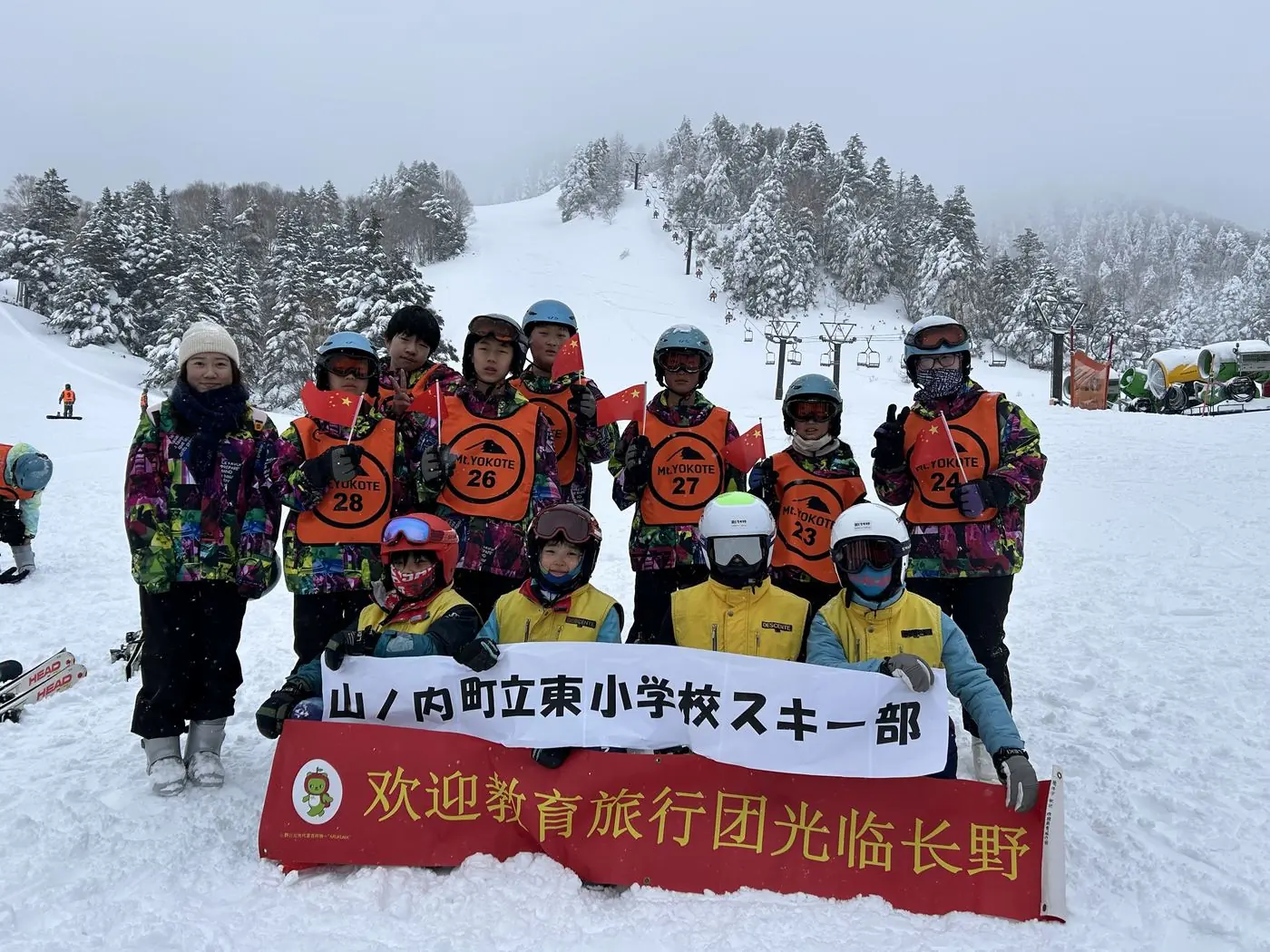
Two groups of children standing together on the snow holding a banner: on one side the local elementary school ski club in dark jackets, on the other visiting children in orange bibs and helmets, the ski run and lift behind them.
The banner reads 山ノ内町立東小学校スキー部 — the ski club of Yamanouchi Higashi Elementary School.
Children eating at long tables in the hotel dining room, trays of food in front of them, snow outside the window.
The hotel dining room with people queueing at the serving counter and eating at tables.

Lunch is in the hotel, which is why the exchange works — everybody comes off the mountain to the same room.

One true thing. This depends on a Japanese school's term calendar and on the prefecture's exchange office. It is not available on demand, it is not available in every week of the season, and it takes about three months to arrange. For groups of ten or more it is usually possible. We will tell you early whether your dates work.


Where you sleep

Two different hot springs, in one building.

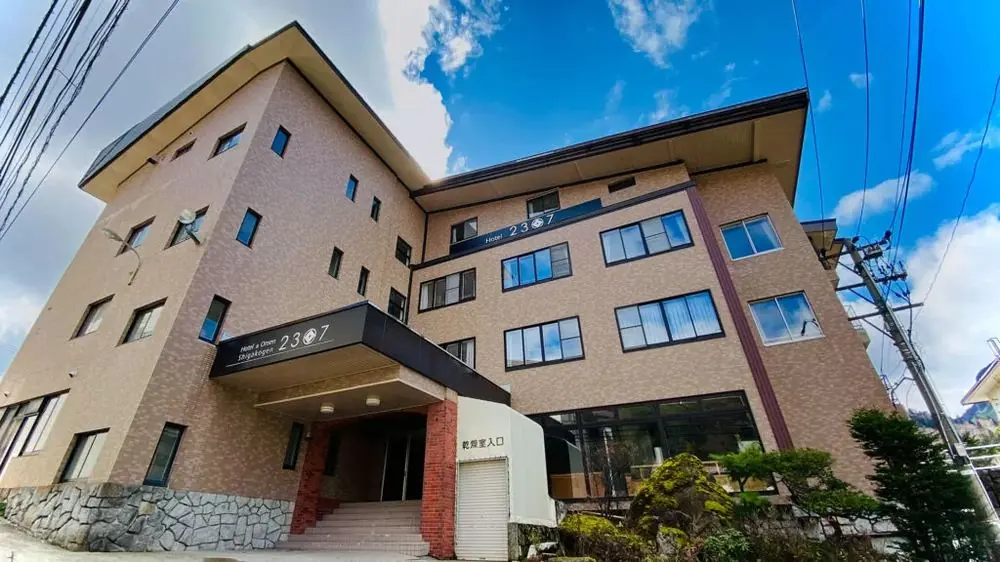
Hotel & Onsen 2307 Shigakogen, at the foot of Mt. Yokote. Four baths, drawing on two separate natural springs.

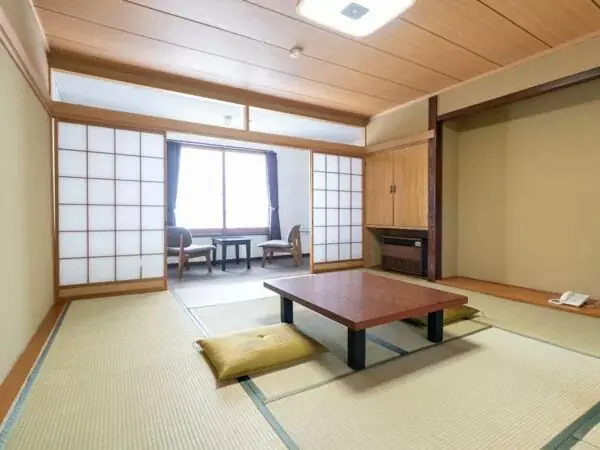
The large indoor bath in the basement is Hotaru Onsen. The open-air bath on the ground floor is Yokoteyama Onsen — a different spring, different water. There is a panorama bath on the fourth floor and a foot bath by the entrance. Rooms are Japanese-style, tatami, normally three or four to a room; two is possible on request.

You walk back to it in three minutes at the end of the day, in ski boots, carrying skis.
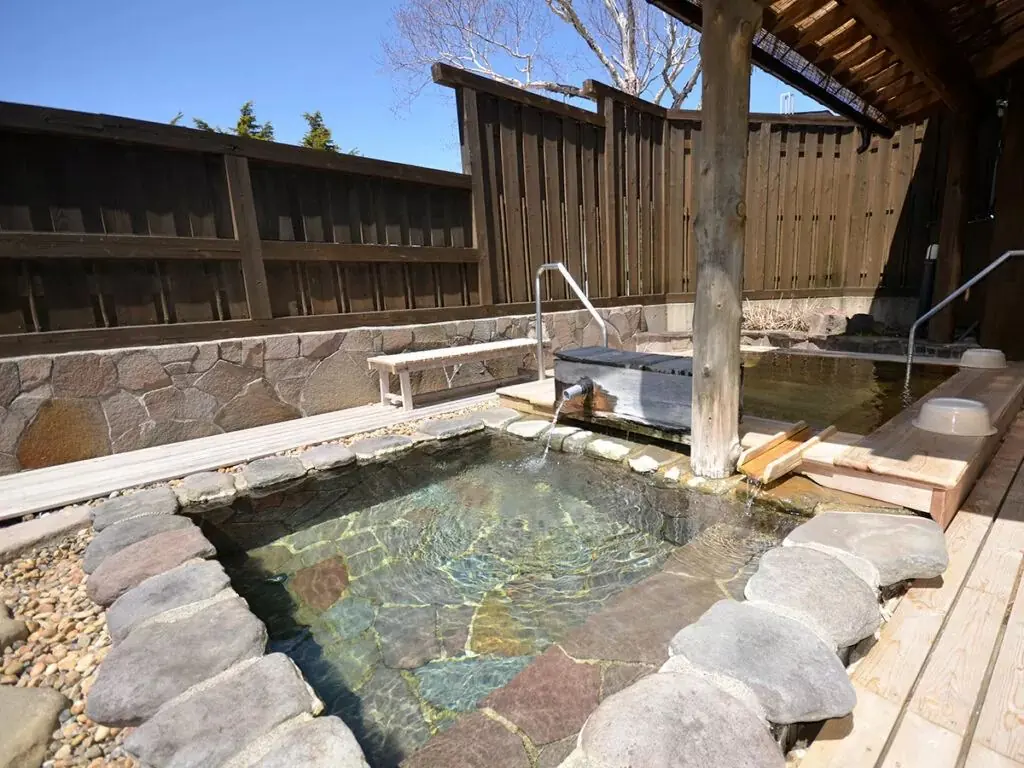
An open-air hot spring bath: a stone-edged pool of clear water under a wooden roof beam, water running in from a spout, a timber screen and blue sky behind, a second bath beyond it.
The ground-floor open-air bath, Yokoteyama Onsen. The water arrives, is used once, and leaves.
A Japanese-style hotel room: tatami floor, a low lacquered table with floor cushions, shoji screens, and a small sitting area with two chairs by the window.
The hotel from outside: a four-storey building with Hotel & Onsen 2307 Shigakogen on the canopy over the entrance, under a blue sky.

Rooms are tatami, normally three or four to a room. The building is on the road at the foot of Mt. Yokote.
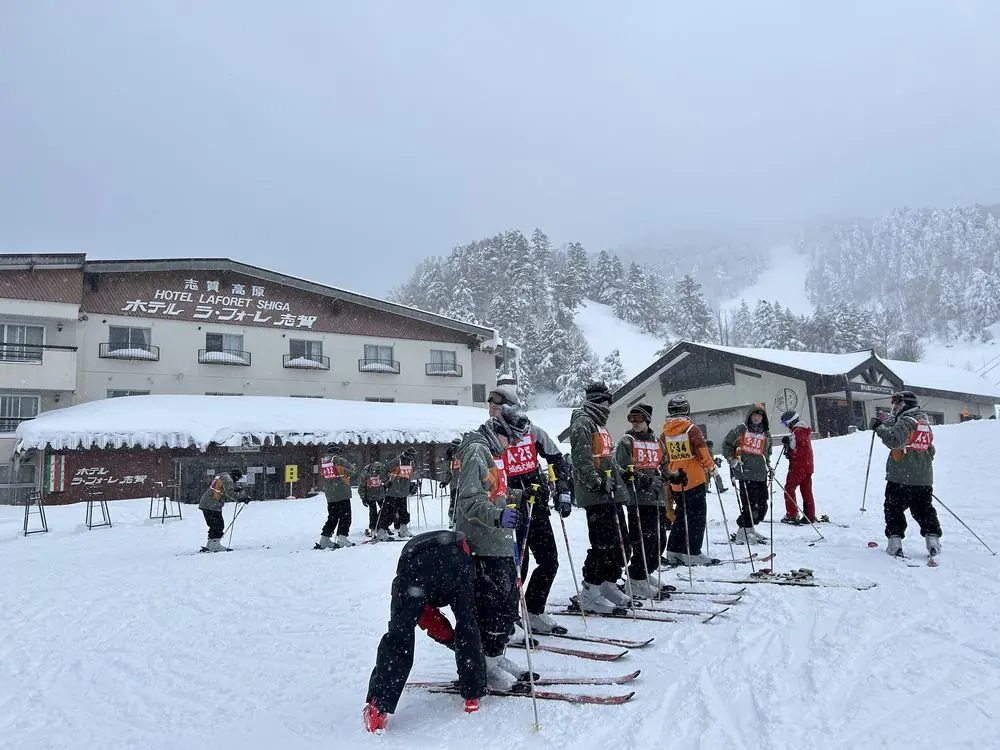
The hotel seen from the snow: a long low building with deep snow on the roof, children lined up on the slope in front of it with skis, an instructor kneeling to help one of them.
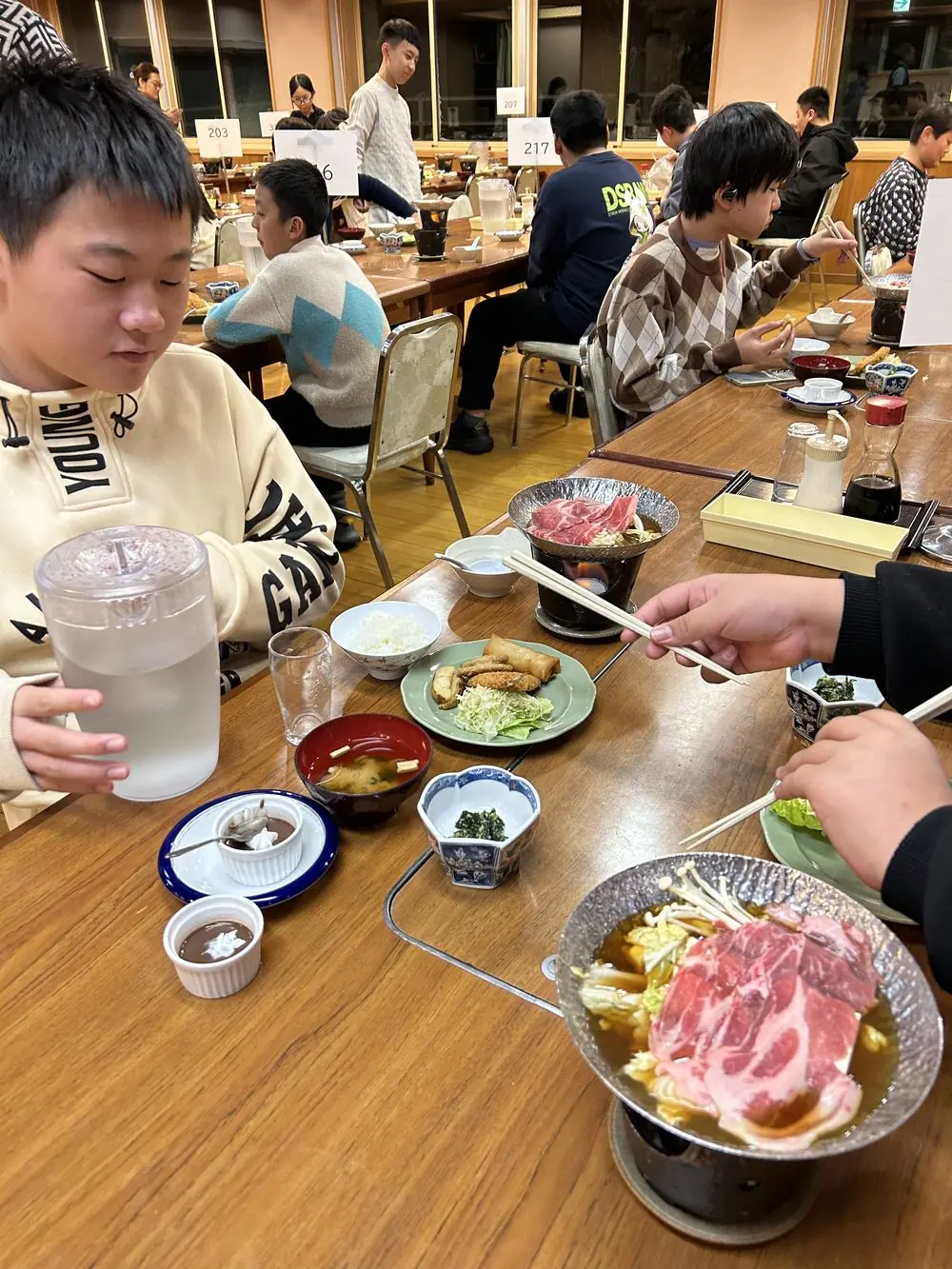
A boy eating at a long dining table, a small hotpot of thinly sliced beef in front of him with side dishes and miso soup.

Left: the run comes down to this. Right: dinner and breakfast are both in the hotel.

Hotel2307Shiga Kogen
Baths4two springs
To the lift3 minon foot
RoomsJapanese3–4 per room
MealsBreakfastand dinner
LocationMt. Yokotebase

One true thing. Three minutes' walk is not ski-in, ski-out, and we will not call it that. And the onsen is a Japanese onsen: you wash first, you go in with nothing on, and it is shared. For some families that is the best part of the trip. For some it is not, and it is better to know now.


Third morning

The snow monkeys are in the same town as the hotel.

Jigokudani Yaen-koen — the valley where wild Japanese macaques come down and sit in a hot spring. It is the photograph everybody has seen, and it is twenty minutes down the mountain from where you slept.

Both the hotel and the park are in Yamanouchi-machi, Nagano. You go on the way home, and then the coach carries on to Tokyo.
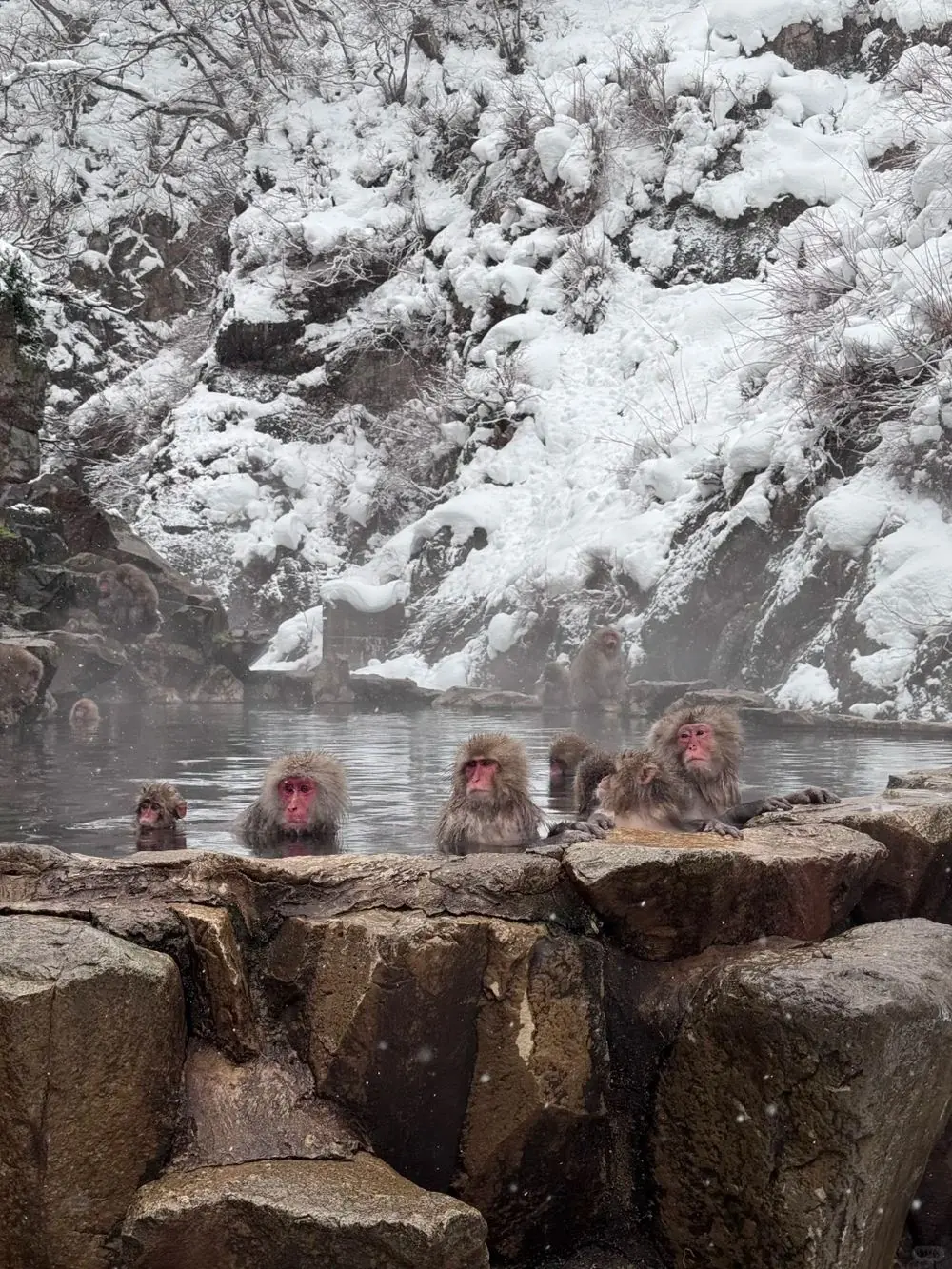
Japanese macaques sitting in a steaming hot spring pool, snow falling, a snow-covered rock face rising behind them.
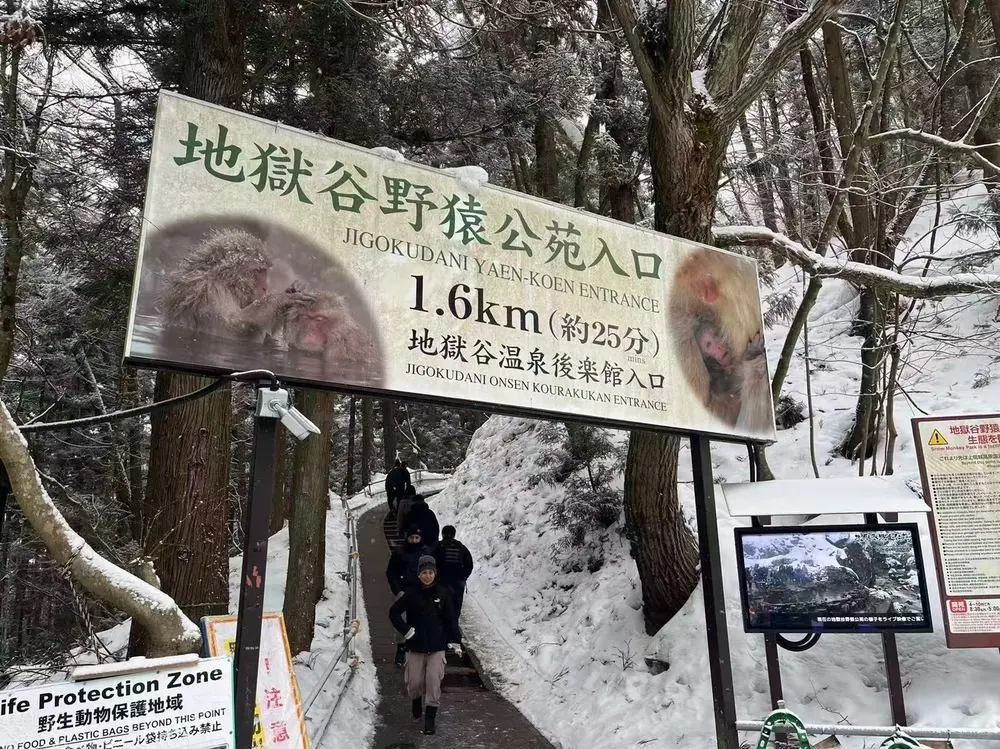
The signposted entrance to Jigokudani Yaen-koen in the snow: a board reading 1.6 km, about 25 minutes, with walkers coming up the cleared path through the trees.

Left: what you came for. Right: the way in. The board says 1.6 km and about 25 minutes.

Winter hours9:00–16:00Nov–Mar
Adult¥800
School age¥400under 6 free
Walk in1.6 kmeach way
ClosedNeveropen year round
Then→ Tokyo

One true thing, and it matters. In winter the lower car park is closed and the forest road is shut, so you walk in from Kanbayashi. The board at the entrance says 1.6 kilometres, about twenty-five minutes. The park itself says about thirty-five. With children who have just skied for two days, allow forty each way, and put them in proper boots. A large coach cannot use the forest road in any season.

And the monkeys are wild. They are fed, which is why they gather, but on some days they do not come down. The park says so itself and so do we.


Optional

Filmed from the air, on the runs they actually ski.

The resort has a drone company based on the mountain under contract. Not a hobby drone we bring along — the operator the resort itself works with, flying under the resort's permissions.

Each group is filmed separately, roughly five to ten minutes of footage, delivered as the original files by download link within a week. Every photograph on this page that is taken from above came from that.
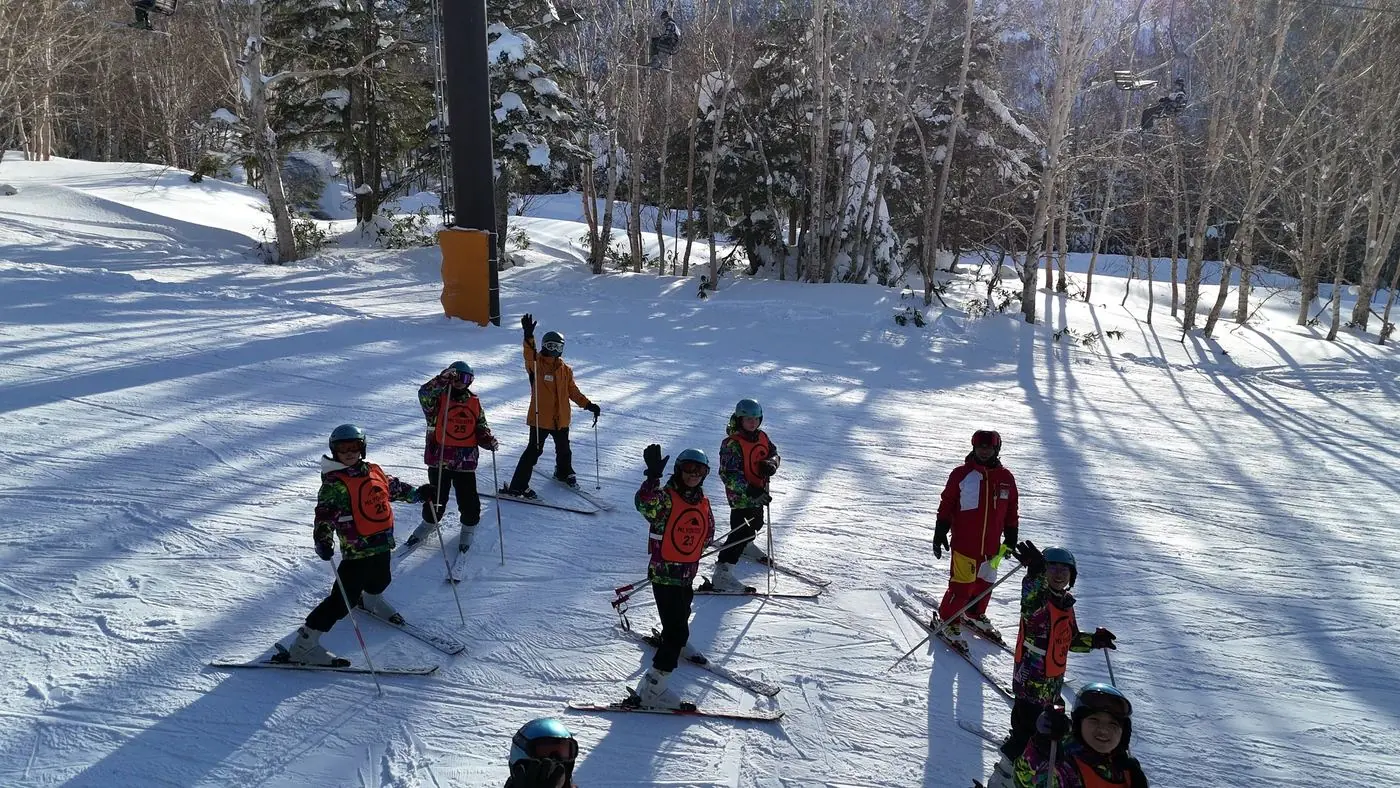
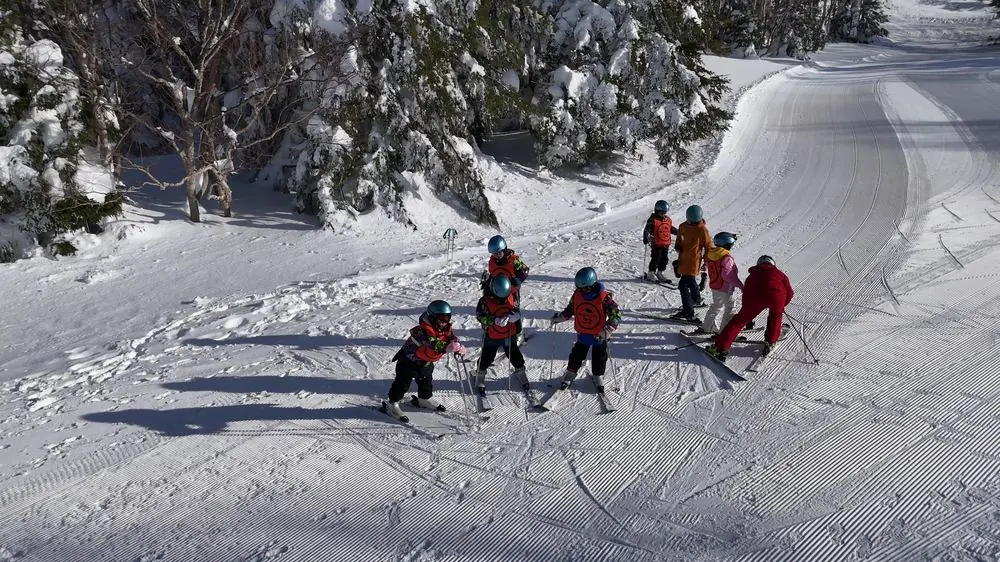
Second afternoon, January 2025. Group four, one child at a time, filmed by the resort's drone operator. Unedited.
From above: a class of children spread out on a wide snow slope among bare birch trees, their long blue shadows stretching across the snow, one child with an arm raised.
From above: a group of children and two instructors gathered on a groomed run, long shadows of snow-covered trees falling across the piste.
A child skiing alone towards the bottom of the run, the lift station and buildings behind.

American families come home from Colorado with shaky phone video. This is a different thing to bring back.

Optional, quoted separately, and it must be booked in advance. Not every resort has this — this one does because the company is based here.


What can go wrong

A child fell and opened his knee. Here is what happened next.

He ran when he should have walked. We took him to the nearest clinic, they X-rayed it to see how deep it was, and the insurance paid.

The reason that was simple is structural: the ski area, the ski school and the lifts belong to one company. When something happens on the mountain, one organisation coordinates with the local medical services — not three organisations pointing at each other. There is a patrol snowmobile parked outside the hotel.
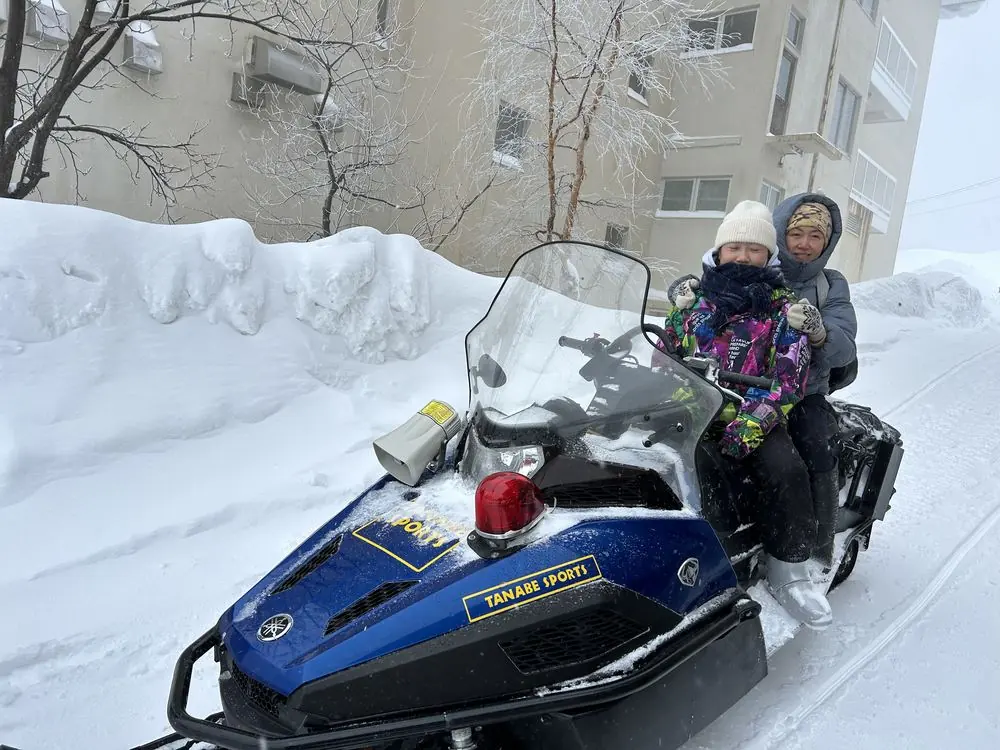
A ski patrol snowmobile marked Tanabe Sports parked in deep snow beside the hotel, with a child and an adult sitting on it.
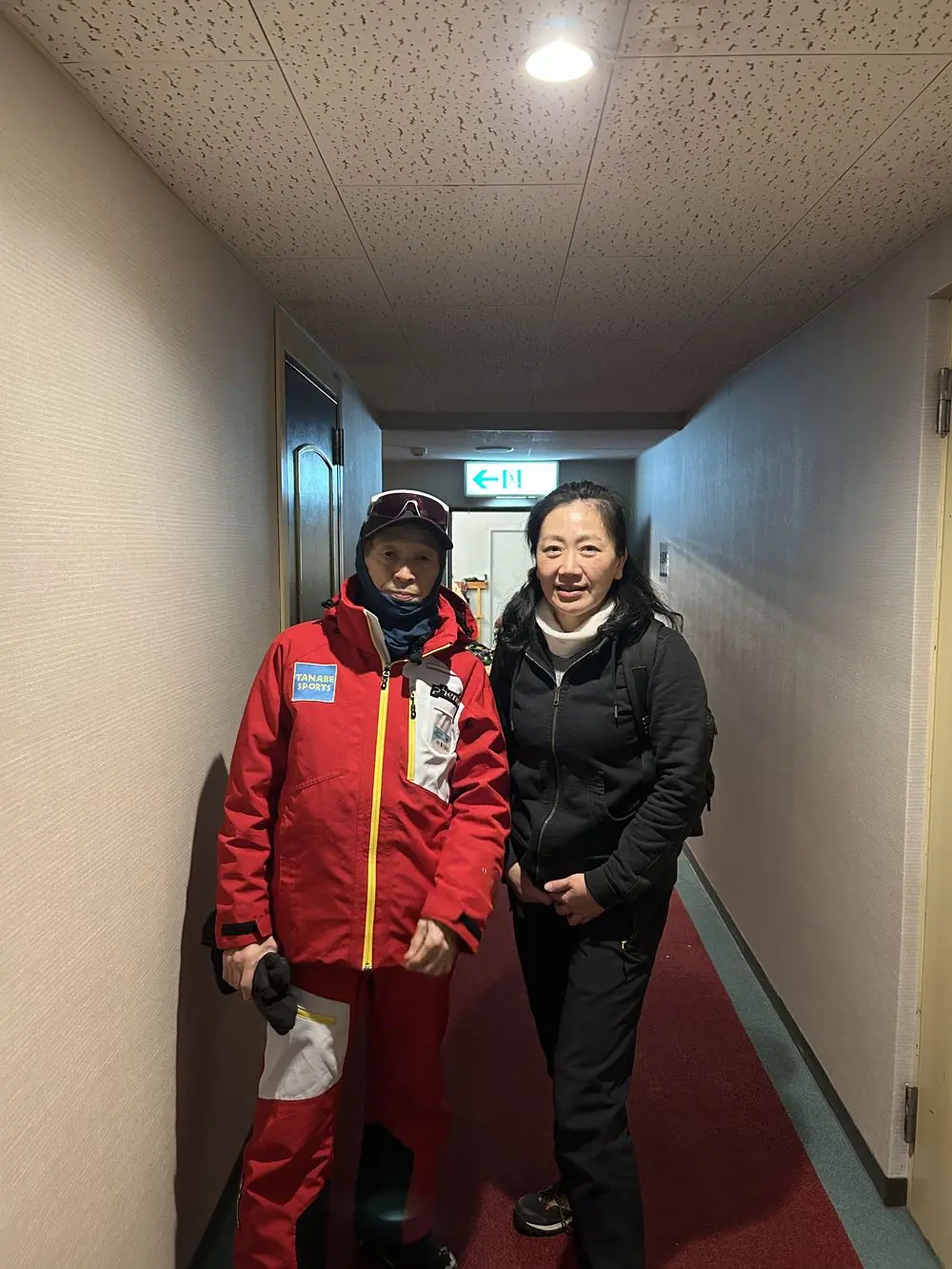
The head of the ski school in a red uniform standing in a hotel corridor with the arranger.

Left: the patrol machine, parked where it is parked every day. Right: the head of the ski school.

01
Snow
High altitude makes Shiga Kogen more reliable than most of Japan, but nobody controls a winter. If the mountain has a bad week, it has a bad week.
02
Wind
Lifts close in high wind. The beginner area runs on lower lifts and closes last — but it can close.
03
Insurance is on you, and we check it
Travel insurance that explicitly covers skiing, bought in your own country before departure. We will tell you what it must cover. We do not take a group without it.
04
Large groups split
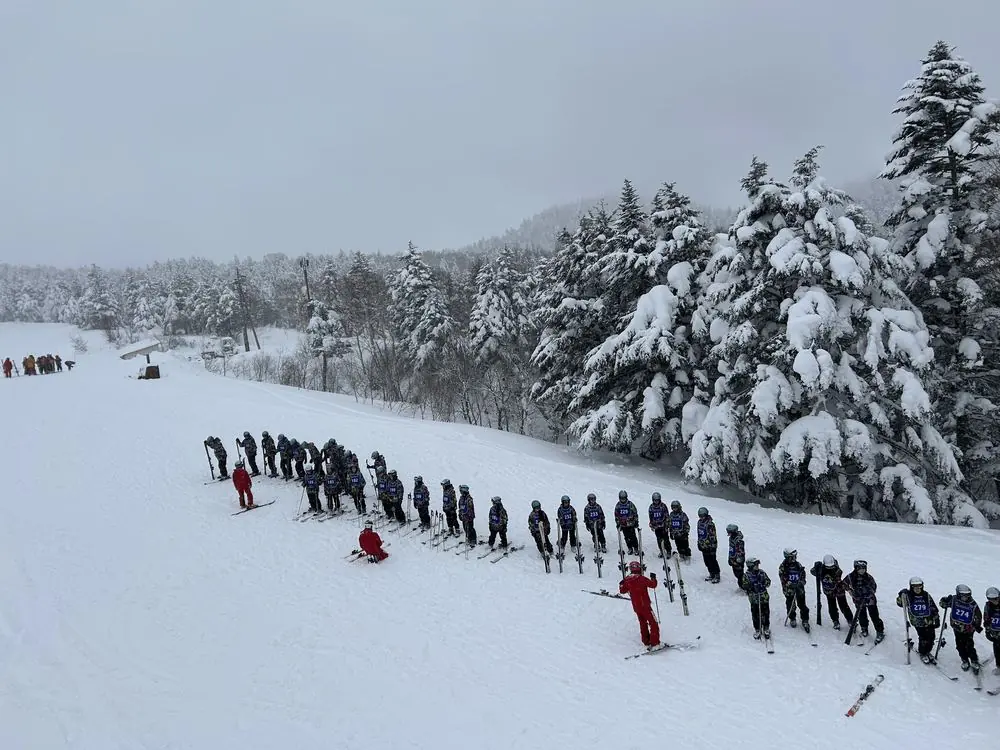
Eighty children went in two groups of forty on staggered timings, two coaches. Above about forty people, the day is run twice rather than run badly once.
Second day, hour by hour

What a day on the mountain actually looks like.

This is the full day. The first day is the drive up and settling in; the third is the monkeys and the road home.

07:00
Breakfast in the hotel dining room
The children put on the snowsuits that were already in their rooms, with their names on them.
09:00
Down to the equipment room
Boots, helmet, goggles, gloves — each one named. The instructors meet them there, not on the snow.
09:30
The lift up
The run is long and gentle. The trees on both sides are loaded with snow.
10:00
Morning lesson — two hours
Ten children per group for a school party, five or six for families. Two instructors on the larger groups.
11:30
The local school's ski club arrives
They ski the rest of the morning with your children.
13:00
Lunch at the hotel, with them
Everyone in the same dining room. This is where the talking happens.
15:00
Afternoon lesson — two hours
Aerial filming this afternoon, if it was booked.
17:00
Onsen, then dinner
Four baths, two springs. Most children go in twice.
Who has done this

Eighty children, January 2025.

A private school from Guangzhou — eighty students in grades five and six, three teachers, two coaches, three days. Run in two groups of forty on staggered timings so that neither group ever waited.

The year before, sixty students and two teachers from a school in Shenzhen, one day's skiing at a resort within reach of Tokyo.

We work with the ski school directly, and with the international exchange division of the Nagano Prefecture tourism organisation — who sent two of their own staff to the mountain on the day, to help coordinate.
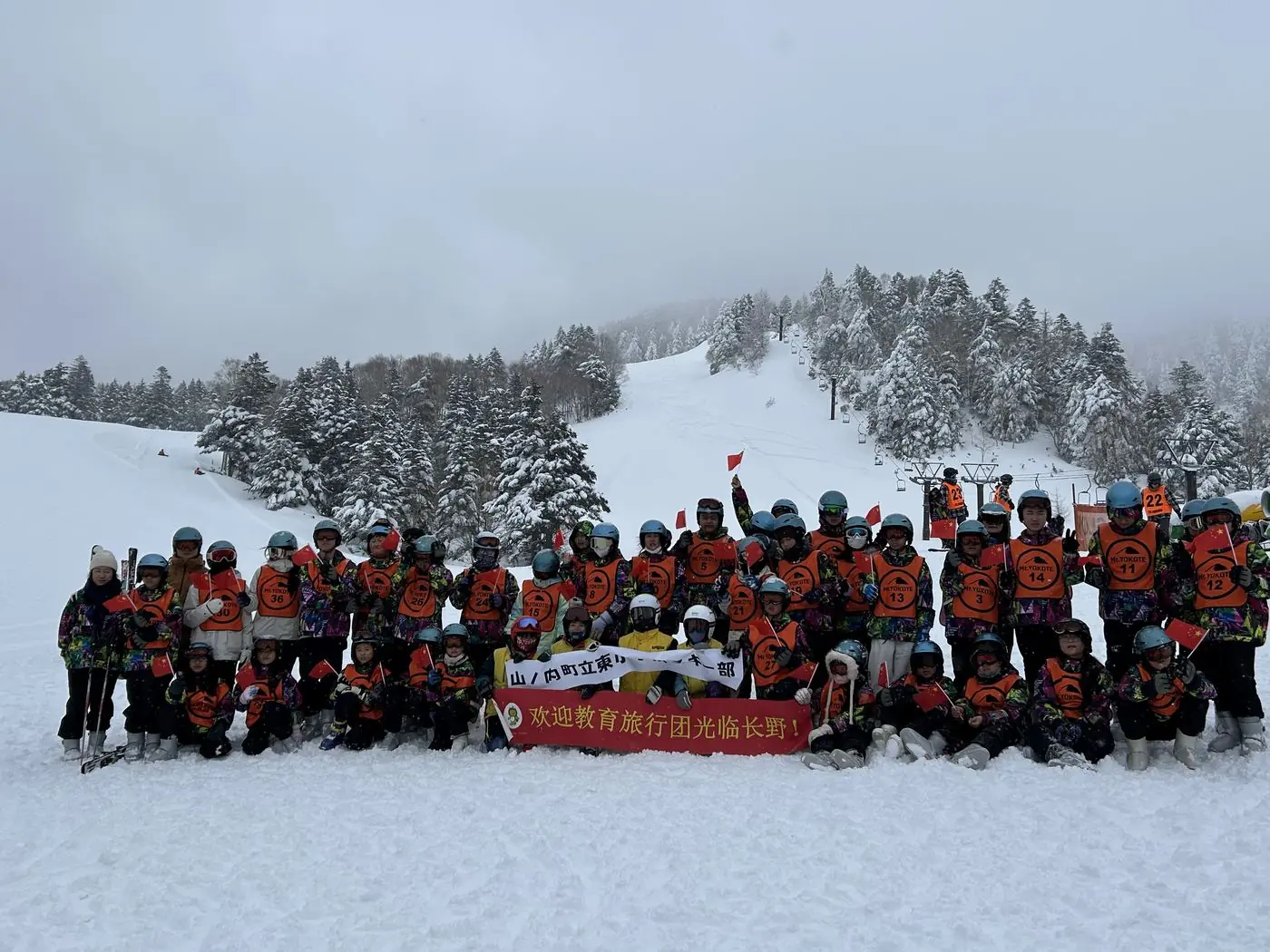
A large group photograph on the ski slope: dozens of children in orange bibs and helmets with their instructors, holding a red banner, snow-covered mountain behind.
January 2025. Eighty children and three teachers.
A long line of children carrying skis walking along a piste, snow-laden trees on both sides.
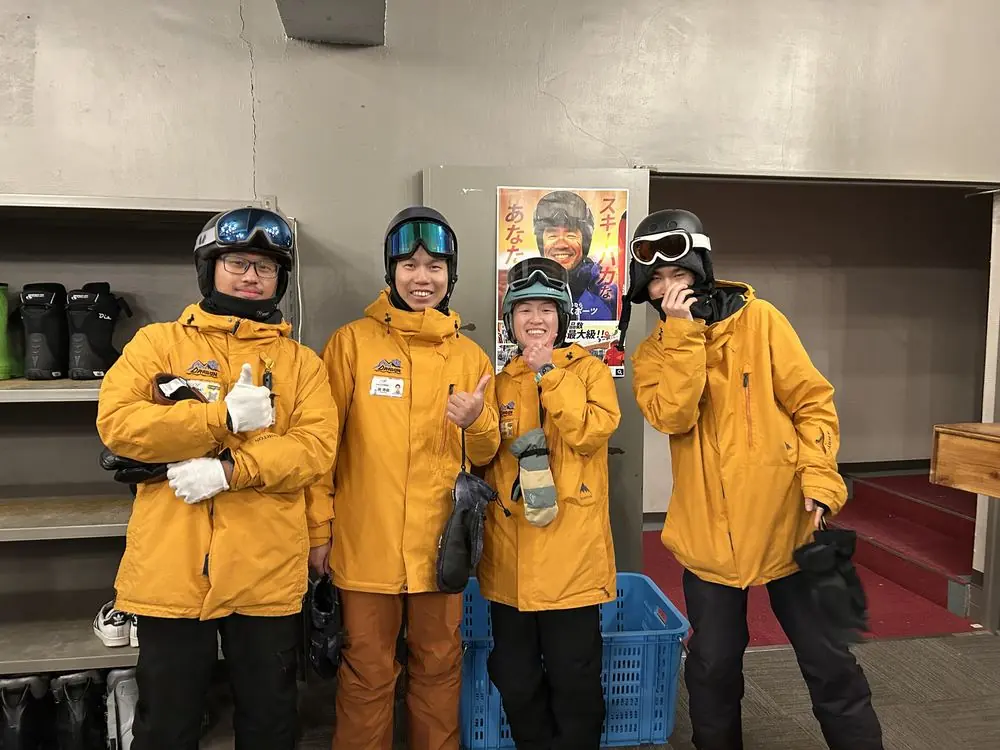
Four members of staff in matching orange jackets standing indoors at the hotel.

Left: moving one group of forty. Right: the people who make that possible.


Practical

What is included, and what is not.

Length3 days2 nights
DepartsYour hotelin Tokyo
Group sizeFrom 102–3 families
AgesBeginnersno experience needed
SeasonDec – late Mar
PricePer groupquoted

Included

  • Coach from your Tokyo hotel and back
  • Two nights, with breakfast and dinner
  • All ski equipment and the snowsuit
  • Lift pass
  • A full day of instruction, in English
  • Snow monkey park admission

Not included

  • Travel insurance covering skiing — required, bought at home
  • Aerial filming — optional, quoted separately
  • Lunches on the travel days
  • Flights

There is no price on this page, on purpose. The number moves with group size — the coach from Tokyo costs the same for six people as for twenty. Tell us how many you are and when you want to come, and we will price it properly. A range would only mislead you.

Next

Tell me your dates and how many children.

That is enough to say straight away whether the school exchange is possible in your week, whether the drone company is free, and what the whole thing costs. If your dates do not work, I will tell you that in the first email rather than the fourth.

Write to Mai

Licensed travel arrangement operator, Japan · Tokyo and Kumamoto